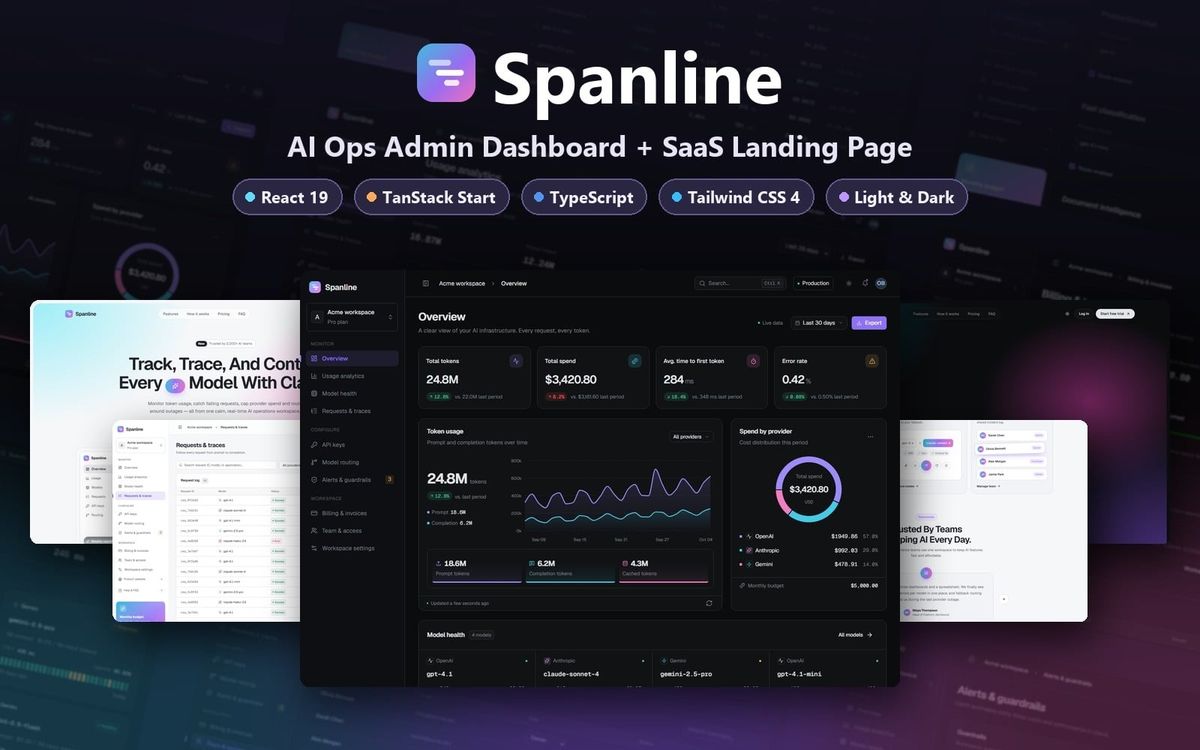
Spanline is a React admin-dashboard template offered through TemplateMonster, with a companion SaaS landing page and authentication screens. Its subject is AI operations: understanding usage, inspecting requests and presenting the controls around a workspace. The public demo uses browser-held sample data and does not call AI providers.
A broad view, then a specific request
The template includes overview and usage screens, model-health views, and requests with search, filters and a trace-waterfall drawer. Those areas present different levels of detail within the same product concept.
The design relationship is the interesting part: a summary raises a question, a filtered list narrows the context, and an individual record provides the detail. A dashboard becomes more useful when the visitor can follow that progression instead of treating each chart as an isolated display.
Include the surrounding administration
The published template scope also includes API-key screens, routing, alerts, billing, team access and workspace settings. These give the interface a broader operational context beyond an analytics homepage.
For a real product, each area would need an agreed relationship with the underlying data and permissions. A budget control, for example, is only meaningful when the interface and the system applying that control share a clear definition of its behaviour.
Connect the product introduction to the workspace
The accompanying landing page introduces the AI-operations concept and links into the demo. Its feature sections preview usage, routing and team interfaces, while the template includes account-entry layouts as part of the wider page collection.
That makes the public website and the application interface two parts of one product presentation. A useful implementation brief can consider the vocabulary, visual system and navigation across both, rather than leaving the marketing pages disconnected from the experience they introduce.
Plan the work beyond the sample data
The demo’s FAQ explains that the sample data can be replaced through the project’s data modules. The marketplace listing identifies the implementation as React, TanStack Start, TypeScript and Tailwind CSS.
Turning a template into a connected application still calls for a defined data model, backend services, authenticated access and behaviour for loading or failed requests. The template supplies a concrete interface starting point; the product brief determines what the finished application must actually do.