MVP development cost in 2026 depends mostly on three things: how much you build, which platforms you launch on and who builds it. As rough market ranges, a simple no-code experiment runs $0 to $5,000, a freelance build $5,000 to $40,000 and an agency build $30,000 to $150,000+. My own MVP builds start at $8,000 and usually take 6 to 10 weeks. Your real number comes from a written scope.
Want a number for your own idea? Try the MVP cost calculator: pick your platform and features and get a budget and timeline in seconds.
I build MVPs for founders, so this question comes up on nearly every intro call. A single figure means very little until you know what sits behind it. This guide covers the decisions that move the budget, the platform choice that affects it most, and a short set of questions you can answer before you ask anyone for a quote.
MVP development cost by build option
The market ranges below are only useful for rough planning. Region, support terms, design and testing all change the final price, so compare proposals that describe the same scope.
No-code tools ($0 to $5,000)
Platforms like Bubble, Glide or Softr can get a simple product live quickly and cheaply. They are good for testing pure demand. You will hit limits once you need custom logic, deeper integrations, AI features or better performance. Plenty of founders build a no-code v1, prove interest, then pay a developer to rebuild it properly. That is a sound plan as long as you budget for the rebuild from the start.
Freelance developer ($5,000 to $40,000)
One experienced full-stack developer can take you from idea to a launched product. The lower end of the range fits a focused MVP built around one feature. The upper end fits products with payments, dashboards, mobile apps or AI features. You get speed and direct communication with the person writing the code. The risk is hiring the wrong person, so vet carefully.
Agency ($30,000 to $150,000+)
With an agency you pay for a team: project manager, designer, several developers and QA. For a funded startup that needs a large product built in parallel, that overhead can be worth it. For a pre-revenue MVP, it often means paying enterprise prices to test a hypothesis. I compare the three options in more depth in my guide to choosing a freelancer, an agency or an in-house team.
What drives the cost of an MVP
Founders often start by worrying about the tech stack. In practice, scope and team structure move the price far more.
Feature scope and user types
The biggest cost driver is how much you are trying to build. Features that look simple carry a lot underneath. A basic login needs secure authentication, password resets and session handling, and often social sign-in. An "add to cart" button touches inventory, payments and order tracking.
The number of user types matters just as much. An app with customers, vendors and admins is really three apps sharing a database. Each role needs its own screens, permissions and testing.
Backend and data complexity
A content app that shows articles from a database is a light backend job. A marketplace that moves money between two parties, verifies identities and handles disputes is a different order of work. Real-time syncing, multi-user permissions and payment logic all add backend time.
Custom builds versus off-the-shelf services
Building your own login, payments or email system adds weeks. Using established services such as Stripe for payments, Auth0 or Supabase for authentication, and Resend for email takes far less time. Every integration still needs setup and testing, especially anything involving payments, so budget for that work even when a service looks easy to plug in.
Design ambition
A clean, simple interface built from a consistent component set is relatively cheap. Custom illustrations, complex animations and unusual UI patterns add design and development hours. Pixel-perfect motion before you have users is money spent on the wrong problem.
AI features
Basic AI integration, such as a chatbot that answers from your documentation or smarter search, is more affordable than many founders expect. In my own work, adding a feature like this to an existing product usually costs $3,500 to $12,000 and takes 2 to 5 weeks, plus the AI provider’s usage fees. Complex custom AI pipelines cost much more, and training your own model is rarely necessary for an MVP. Add AI where it removes friction for users or cuts operating cost. My guide to where AI integration pays off goes into this in more detail.
Native, cross-platform or web first
Platform is one of the earliest decisions you make, and it affects cost, timeline and long-term maintenance.
A web app is one product. Separate native apps for iOS and Android mean two codebases, so every feature is built, tested and updated twice. That can roughly double the mobile budget. Native still makes sense when the app depends heavily on device hardware, needs maximum graphics performance, or is a flagship product with the budget to match.
Cross-platform frameworks like React Native and Flutter let one codebase run on both iOS and Android, with platform-specific adjustments where needed. For most business, content, commerce and consumer apps, that is the faster and cheaper path, which is why I recommend it for most startups. I cover the trade-offs in cross-platform vs native apps.
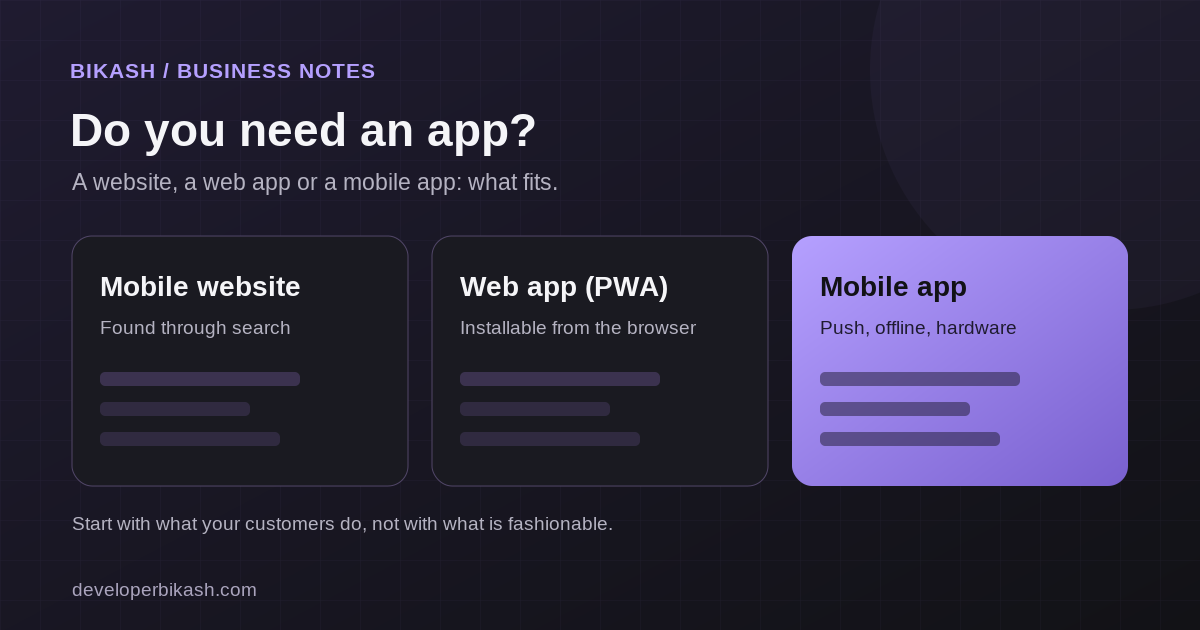
Sometimes the best first move is a mobile-responsive web app with no app store at all. If your core value does not need push notifications, offline access or the camera, a web app lets you test with real users on any device without store reviews or a second codebase.
When mobile is part of the plan from day one, it helps to see what a finished release involves. My InstaFit, a fitness and coaching app I built with Capacitor, is published on Android and iOS from one codebase and brings workout logging, training plans, nutrition tracking and progress into one app.
How to reduce MVP cost without cutting corners
The cheapest MVP is a small one. The founders who keep costs under control make deliberate trade-offs instead of cheap ones.
- Build one core feature well. Write down the three to five features you cannot launch without and move everything else to a phase-two list.
- Use a spreadsheet or a simple admin tool instead of a custom admin panel for v1.
- Use off-the-shelf services for everything that is not your unique value.
- Choose a proven stack so your developer is not solving problems that already have well-documented answers.
- Settle the design in Figma before coding starts. Moving a button in a design file costs far less than rebuilding a coded screen.
Here is a test I give founders: if you removed this feature, could a user still get the core value? If the answer is yes, it is not v1. A feature you postpone can still be built later, paid for by revenue instead of savings.
Costs that come after launch
Spending continues after launch. Budget beyond the initial build for hosting, paid third-party services and API usage, bug fixes, maintenance and the changes your first users will ask for. If you publish mobile apps, check the current Apple and Google developer program fees. Check provider pricing directly before you commit, and keep a contingency for post-launch changes sized to your project and budget.
A budgeting framework to use before you ask for quotes
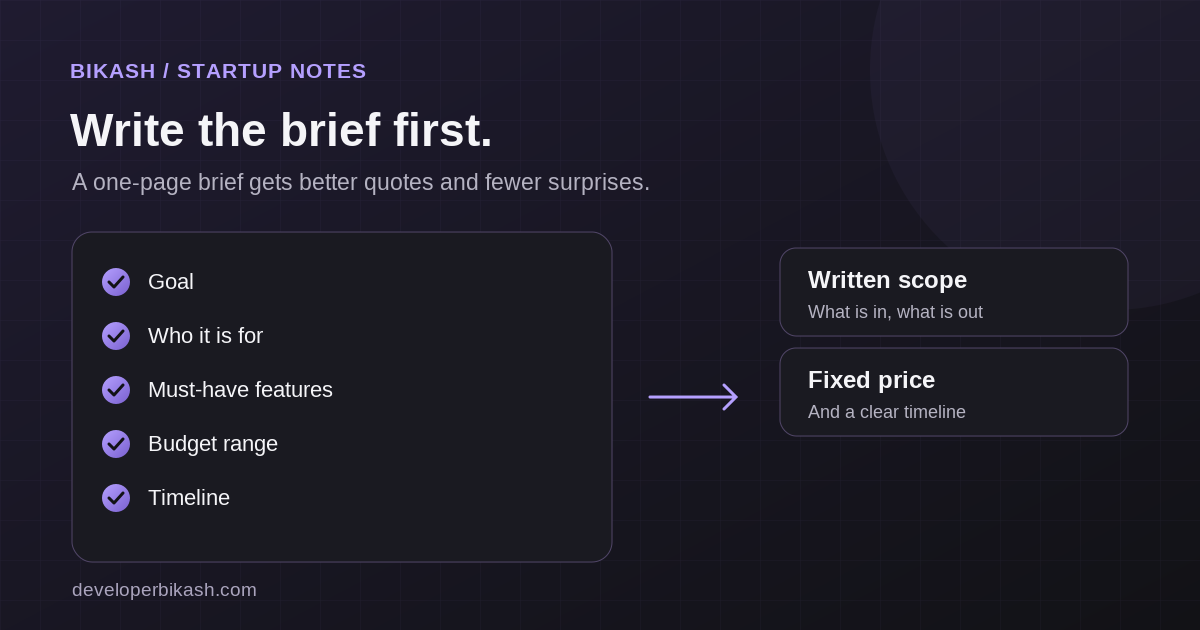
"How much does an app cost?" is too broad to answer. These six questions map to the cost drivers above and turn a vague idea into a brief a developer can price:
- What is the smallest version of the product that tests my core value proposition?
- Does it need to be a mobile app, or can it start as a responsive web app?
- If mobile is required, do I have a specific reason to go native, or will cross-platform work?
- How complex is the backend? Simple content, or real-time, multi-user and payment-heavy?
- Which integrations must exist at launch, and which can wait?
- Do I need a full team working in parallel, or can one experienced full-stack developer cover the stack?
Bring the answers to your first call. You will get more accurate quotes and fewer surprises halfway through the build.
How I price MVP work
I scope MVP work before I quote a fixed price. The written proposal sets out the deliverables, the demo schedule, the acceptance criteria and how the code is handed over to you. Check that any proposal you receive, from me or anyone else, covers those four things. You can read how I approach this on my MVP development service page.
As a guide to my current pricing (October 2026):
- Focused MVP web app: from $8,000, typically $8,000 to $25,000, in 6 to 10 weeks.
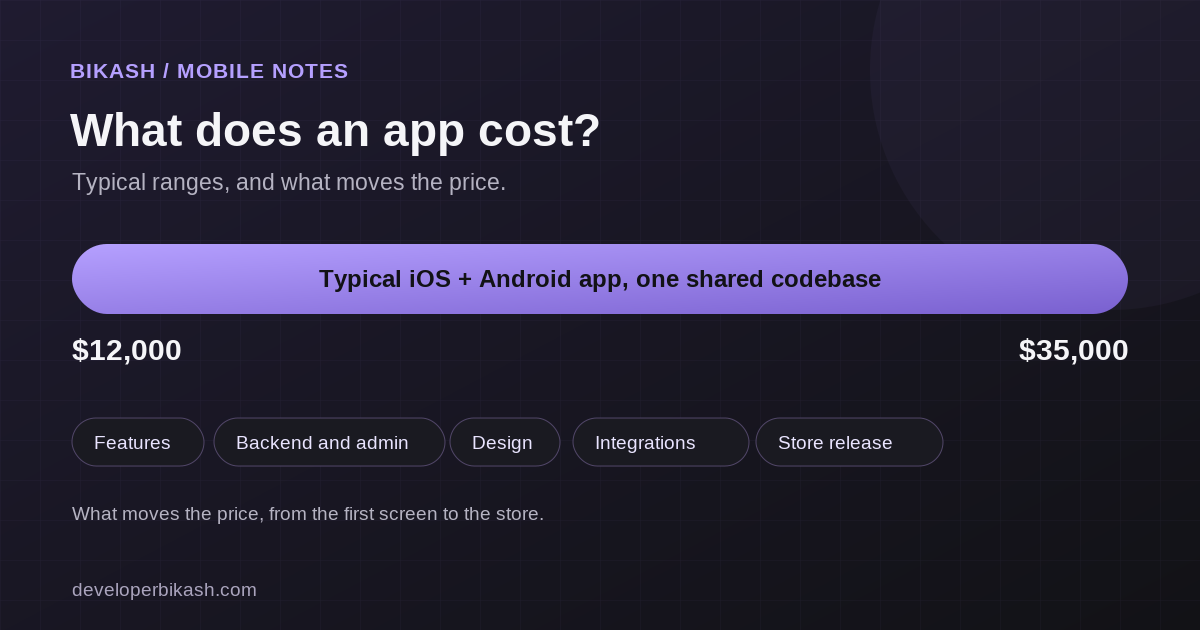
- Cross-platform mobile app for iOS and Android: from $12,000, typically $12,000 to $35,000, in 8 to 14 weeks plus app store review.
- AI feature in an existing product: from $3,500, typically $3,500 to $12,000, in 2 to 5 weeks.
The final price is fixed in the written scope before work starts, so you know the number before you commit.
Frequently asked questions
Can I build an MVP for under $5,000?
Yes, if the scope is truly minimal: one user type, one core feature and off-the-shelf services for everything else. That constraint is often healthy for a first release.
Is it cheaper to hire a developer in another country?
Rates vary a lot by region, and remote work is routine now. Location matters less than a record of shipped products and communication you can follow.
Should I wait until I raise funding to build?
Usually the opposite. A working MVP with early users is often what makes fundraising possible, and a small v1 gives investors something real to look at.
How long does an MVP take to build?
A focused scope may fit a 4 to 8 week planning window, but dependencies, feedback rounds and release requirements can change that. My app development timeline guide breaks it down.
Do AI features increase MVP cost much?
Connecting an existing AI model API for search or a support assistant adds a moderate amount. Building custom AI pipelines or models adds much more and is rarely needed for a first release.
If you have an idea and want a real number for it, I will scope it honestly, including what I would cut from v1. See how I work on the MVP development page, send me a message, or book a 30-minute call.