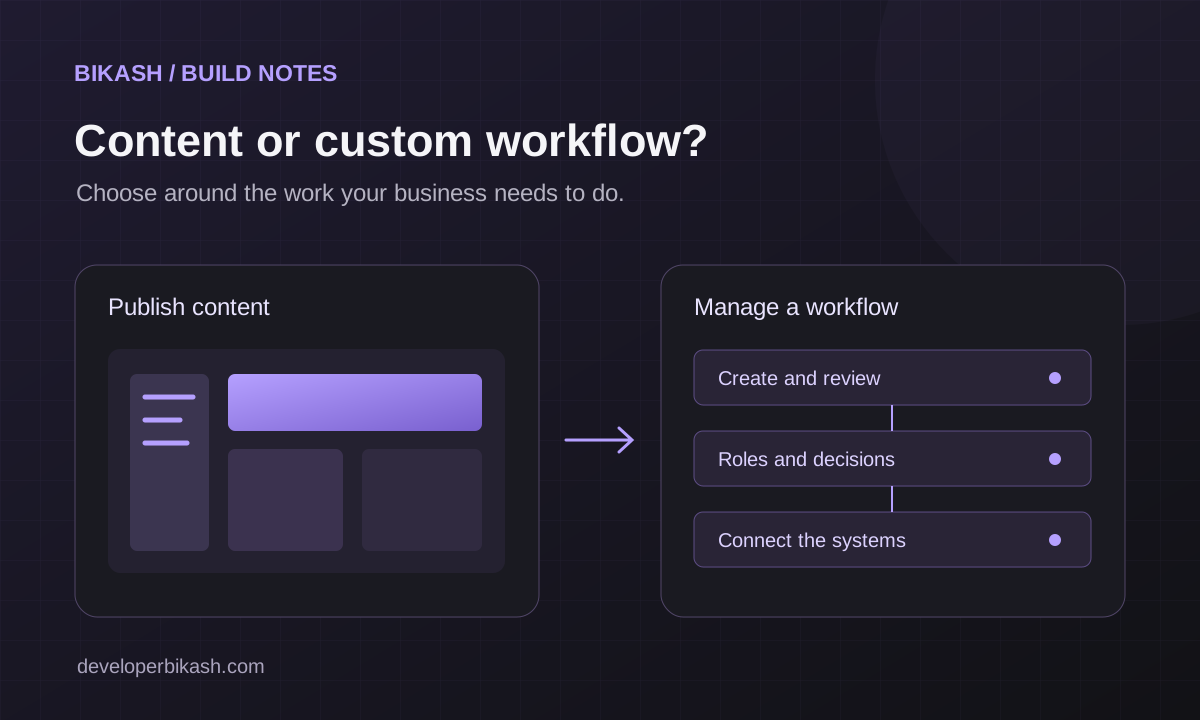
The useful starting question is what your team and your customers need to do each week. A business that mainly publishes services, articles and property information has a different problem from a business running approvals, private customer accounts or several connected systems.
Write down those workflows before choosing a framework. The platform should support the work, the people maintaining it and the budget available after launch.
Start with a normal week
List the people who will use the website. For each person, describe one task in plain language: an editor publishes a new service, a visitor requests a viewing, a customer checks an order, or a manager approves a request.
Then record the information each task reads or changes, the people allowed to do it, and what should happen when something goes wrong. This short exercise often reveals whether you need a content website, an application, or a combination of the two.
When WordPress is a useful fit
WordPress is a sensible option when managing and publishing content is central to the project. Think about service pages, articles, staff profiles and structured listings that an internal team must update regularly.
The editorial experience matters as much as the public design. Ask to see how a non-developer will add a page, replace an image, preview a change and recover from a mistake. A carefully structured editing interface can reduce the number of routine requests sent back to the developer.
The Coalson project illustrates a property website with listings, detailed property information and broker contact routes. The useful planning questions are about the information a buyer needs and how the business will maintain it.
When a custom application is worth considering
A custom application deserves consideration when business rules drive the experience: different users see different records, work moves through approval stages, or actions depend on several external systems. Those requirements can make an application-specific interface valuable.
Describe the workflow before deciding which tools will implement it. A support experience, for example, may need search, guided answers and a route to a human team. The KAKR Support project provides a relevant example of that kind of product journey.
A JavaScript framework does not remove the need to plan content, access control, operations or search visibility. Nuxt supports different rendering approaches, including server-rendered and prerendered pages; the appropriate choice depends on how frequently information changes and how it is used. See the official Nuxt rendering guide.
Compare the whole project
| Question | What to establish |
|---|---|
| Who updates it? | The editor’s tasks, permissions and training. |
| What must connect? | The systems involved and who owns each integration. |
| What changes often? | Content, product data, business rules or all three. |
| Who maintains it? | Responsibility for hosting, updates, backups and support. |
| What does launch include? | Content migration, testing, redirects, handover and monitoring. |
Ask for these items to appear in the scope. Comparing two headline prices is difficult when one proposal includes migration and maintenance planning and the other only includes the initial interface.
Plan for maintenance from the beginning
Keep a clear inventory of themes, plugins, integrations and other dependencies. The WordPress administration guidance emphasizes keeping WordPress, themes and plugins current. That work needs an owner and an update process; it should not disappear from the plan after launch. Read the WordPress security guidance.
For either approach, agree on backups, restoration, access handover and how changes will be tested. These responsibilities are part of the running cost of the website.
Turn the choice into a brief
A useful first brief names the audience, lists the three most important tasks, identifies the content owner and describes the integrations. Add examples of what is working poorly today and what a successful launch should make easier.
From there, explore WordPress development or Nuxt.js development, and compare the approach against your actual workflow. If the idea still needs shaping, start with a project conversation.