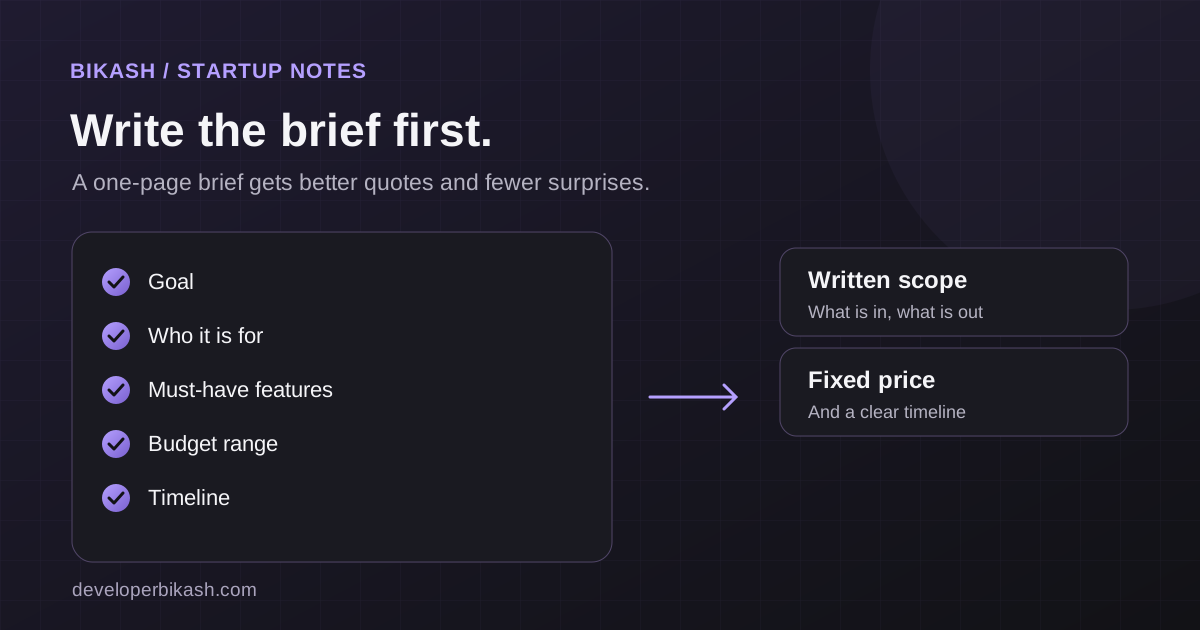
A good project brief is one or two pages that tell a developer what you want to achieve, who it is for, what must be included, what you can spend and when you need it. With that, a developer can give you a realistic quote and ask useful questions. Without it, you get vague estimates, long email threads and a project that drifts.
You do not need technical language. The best briefs I receive are written by people who know their business and describe it plainly. This guide shows what to put in, gives you a template to copy, and lists the habits that make quotes better.
Why a brief matters
A quote is only as accurate as the information behind it. If two developers read a one-line request like "I need an app for my restaurant", they will imagine two different products and quote two very different prices. A brief makes the work comparable, protects you from paying for things you did not want, and shows the developer you are serious, which usually earns a faster and more careful reply.
It also helps you. Writing the brief forces you to decide what the project is for, and that is often the most valuable part.
What to include in a project brief
- The goal. What should be different when the project is finished? More enquiries, fewer support emails, online bookings, faster onboarding? One clear goal beats a list of wishes.
- Who it is for. Describe the people who will use it and what they are trying to do. Customers, staff and administrators often need different things.
- What you have today. Link your current website or app, name the tools you already use and say what is not working. Mention accounts, hosting and any content you already own.
- Must-have features. List what the first version cannot launch without. Keep this list short.
- Nice-to-have features. Put the extras here so they do not inflate the first quote, and so the developer can plan for them.
- Examples you like. Share two or three sites or apps you admire and say what you like about each. Also share one you dislike and why.
- Integrations. Payments, email tools, a CRM, booking software, accounting, or any system the project must talk to.
- Content and design. Say whether you have a logo, brand colors, copy and photos, or whether you need help creating them.
- Timeline. Give your ideal launch date and explain why it matters, for example an event or a season. A real deadline helps the developer plan.
- Budget range. Share a range, even a wide one. It does not mean the developer will spend it all. It lets them propose the right size of solution instead of guessing.
- How decisions get made. Say who approves work and how quickly you can give feedback. Slow approvals are a leading cause of delay.
- How you will measure success. For example, a number of enquiries per month, or a task that should take half the time.
A project brief template you can copy
Paste this into an email or document and replace the prompts with your own answers.
Project name: A short working title.
Goal: What should change when this is finished?
Who it is for: The main users and what they want to do.
What exists today: Links, tools in use and what is not working.
Must-have features: The few things the first version needs.
Nice-to-have features: Ideas for later.
Examples I like: Two or three links, with a note on what I like.
Integrations: Systems it must connect to.
Content and design: What I have, and what I need help with.
Timeline: Target launch date and the reason for it.
Budget range: From and to.
Decision makers: Who approves, and how fast.
Success looks like: The result I want to see.
If you prefer a guided version, the brief tool on my contact page asks these questions one at a time and puts the answers together for you.
A weak brief and a strong brief
| Weak | Strong |
|---|---|
| "I need a website like Airbnb." | "I run guided tours in three cities. Visitors should be able to see dates, book a place and pay a deposit. I handle about 40 bookings a month by email today." |
| "As soon as possible." | "We want it live before the spring season opens on April 1, and our team can review each stage within two days." |
| "Budget is flexible." | "We expect to invest between $10,000 and $15,000 and would like to know what each phase would include." |
| "It should be modern and easy to use." | "We like how the checkout feels on this site and want something similarly simple, in our green and white brand colors." |
Common mistakes to avoid
- Describing the solution instead of the problem. "Add a chatbot" is a solution. "Customers wait a day for answers to simple questions" is a problem, and a developer may suggest a better fix.
- Hiding the budget. Developers cannot size the project to your budget if they do not know it. A range builds trust and saves a round of emails.
- Listing everything as a must-have. If every feature is essential, none are. Be willing to rank them.
- Forgetting who supplies the content. Text, photos and approvals from your side are part of the schedule.
- Leaving out the stakeholders. If a partner or manager will have strong opinions, bring them in before the work starts, not after the first design.
What happens after you send a brief
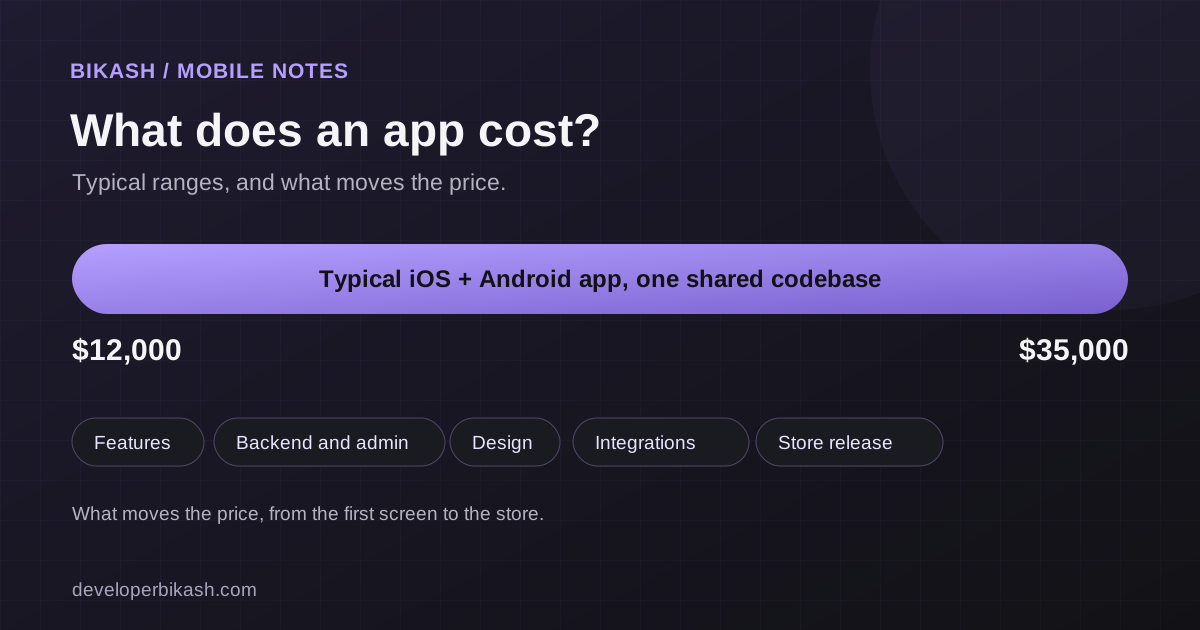
When I receive a brief, I read it, reply with a few questions to close any gaps, and then write a scope that lists what is included and what is not. From that I give a fixed price and a timeline. If you are not sure where your project fits, the MVP cost calculator gives you a quick budget range before you write anything. For a sense of typical prices, see MVP development cost in 2026 and mobile app development cost. If you are still deciding who to hire, my comparison of a freelance developer vs an agency can help.
Frequently asked questions
How long should a project brief be?
One to two pages is plenty. Clarity matters more than length. If you can answer the template questions in a few sentences each, you have enough.
Should I share my budget with a developer?
Yes, as a range. It helps the developer suggest a solution that fits, and it stops you from getting quotes for something you cannot afford. A trustworthy developer will not simply charge the top of your range.
What if I do not know the technical details?
You do not need to. Describe what the project should do for your customers and your team, and let the developer propose the technical approach. Say so in the brief and ask for options.
Can I send a voice note, video or sketch instead?
Yes. A short screen recording of your current site or a photo of a hand-drawn layout often explains more than a page of text. Add a few written lines on the goal, timeline and budget alongside it.
If you have a brief ready, or only a rough idea, send it over and I will reply with questions and a realistic next step. See my MVP development service, tell me about your project, or book a 30-minute call.